Read the announced requirement
A target, current score and legal-ball allocation belong to the same restart record.
An interruption creates a gap between the last visible state and the conditions under which play may continue. The score on the screen can remain the same while the available time and deliveries change. Rain Room is an independent reading journal about that gap: how to follow the announcement, distinguish an old requirement from a revised one and avoid turning a simple average into a substitute for the official method.
Our worked requirement is fictional. Suppose a restart announcement gives a target of 132, with the chasing side on 85 and thirty-six legal balls remaining. The side needs forty-seven more runs to reach that stated target. This page does not calculate how 132 was produced, and it does not present those numbers as DLS output. The example begins after an invented announcement so that the reader can practise interpreting a requirement without inventing the target-setting process.
Play stopping tells the reader that an interruption has occurred. It does not by itself establish whether the match will resume, whether an allocation will change or whether a result can be reached. Those questions depend on the actual circumstances and applicable playing conditions. Keep the status separate from a forecast about what the officials will decide next.
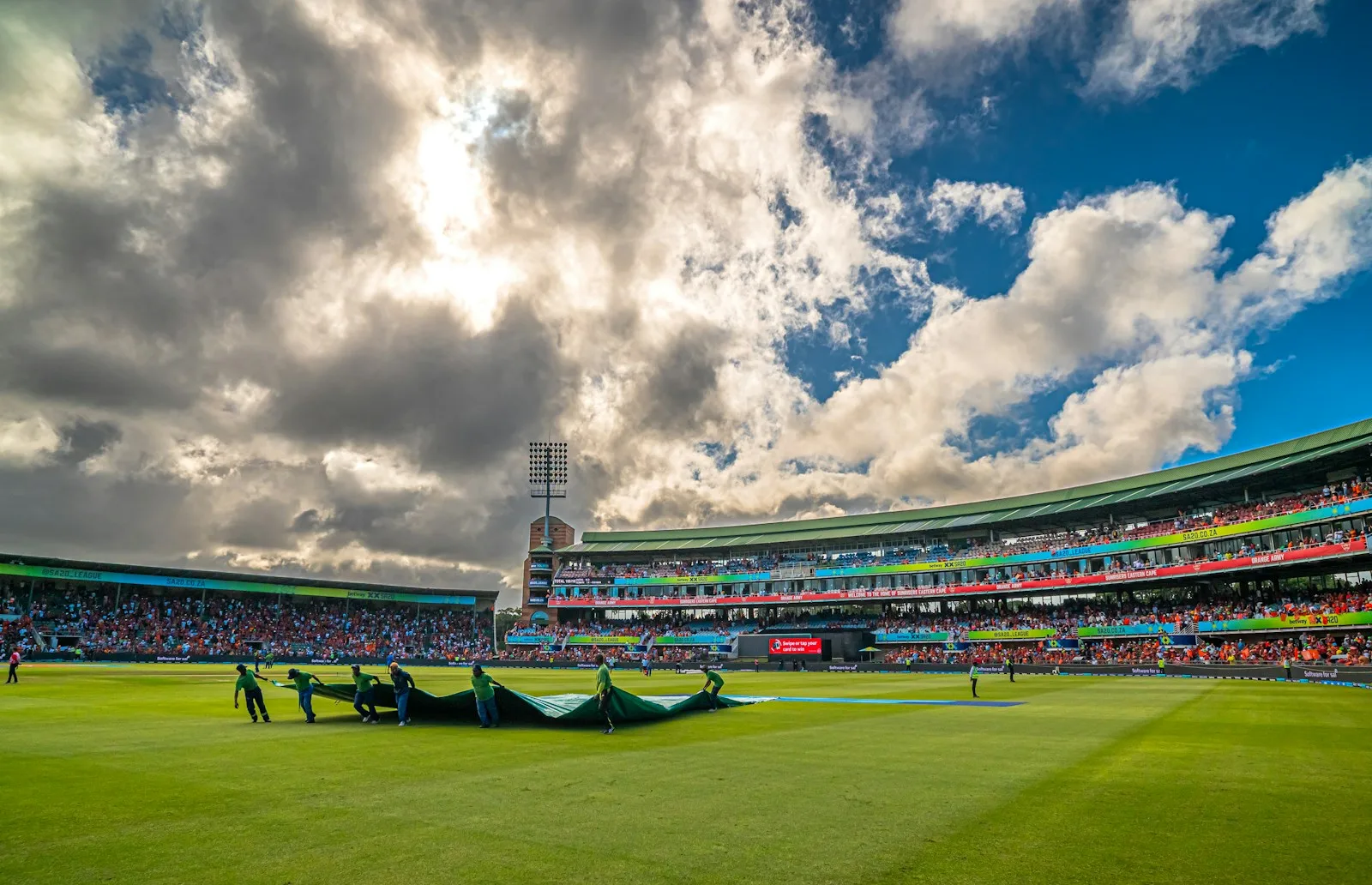
A photograph of covers can illustrate a stoppage, but it cannot establish today's restart time or the condition of a particular playing area. The image may come from another match or another season. Read the caption and current source information rather than treating a familiar stadium view as a live operational update.
When following a developing interruption, identify the latest reliable announcement and its time. A planned inspection and a confirmed restart are different statements. If a page still shows an earlier plan, do not assume that the plan became reality merely because its scheduled time has passed.

The last recorded score, wickets and legal-ball position provide the starting context. Keep their labels together. A runs total without an innings identity can be confused with the first side's completed score, while an over notation without interpretation can lead to the wrong count of deliveries used.
In standard six-ball notation, twelve overs and three further legal balls represent seventy-five legal balls. They do not represent twelve point three decimal overs. If you need to compare allocations, first convert the notation correctly. This arithmetic step is separate from deciding which revised allocation the match conditions permit.
Also distinguish the score at the stoppage from a later corrected record. A change to an earlier entry does not necessarily mean another delivery occurred during the pause. Preserve the chronology so that a reader can tell whether the match state changed or its representation was amended.
A revised target and a revised allocation should be read as a connected announcement. An old target paired with a new number of balls can produce a plausible-looking but irrelevant required rate. The correct calculation starts with the requirement that now applies to the identified innings.
Record whether the announcement gives a target to reach, a par score for a stated interruption point or another specific condition. Those labels are not interchangeable. A reader who removes the label may create an off-by-one error or apply a value at the wrong moment. Use the exact meaning supplied by the official record.
If the announcement is incomplete or a source is unclear, retain that uncertainty. A live-looking graphic does not justify filling a gap with a remembered number from another match. Waiting for a clear statement is more accurate than constructing an unofficial target that the match is not using.
In our invented example, the stated target is 132 and the current score is 85. Subtracting gives forty-seven runs needed. Thirty-six legal balls remain, which is six six-ball overs. The required rate is therefore forty-seven divided by six, approximately 7.83 runs per over. Every part of this calculation follows from the stated fictional requirement.
The arithmetic does not establish how likely the chase is to succeed. Wickets, batters, bowling, conditions and the actual sequence remain relevant. A required rate is a description of the remaining task under its assumptions, not a probability or a guarantee. Keep that distinction visible when the number is displayed prominently.
The example also assumes that the announced requirement remains unchanged during this passage. A further interruption could lead to a new announcement under the applicable conditions. Do not keep applying the earlier fictional calculation after one of its inputs has been replaced.
Invented announced requirement, not DLS output. 47 ÷ 6 = 7.83 runs per six-ball over, rounded.
DLS addresses interrupted limited-overs matches through a method that considers the resources available, including overs and wickets. A proportional reduction based only on lost overs does not capture that relationship. Knowing the previous average scoring rate is therefore not enough to reconstruct the official revised target.
The interaction matters. Deliveries remaining and wickets available are related resources rather than two independent labels that can be ignored in turn. This is an explanation of why the problem is more involved than a direct proportion, not a substitute table of coefficients or an implementation of the official method.
For an actual match, follow the calculation and announcement made under its playing conditions. This page deliberately avoids a homemade DLS calculator. A simple tool that gives an exact-looking answer from incomplete inputs could make the reading problem worse by hiding the assumptions it failed to include.

A target identifies the score required to win in the relevant chase context. A par score used at an interruption point belongs to a particular comparison under the method and conditions. Do not replace one label with the other simply because the values appear close or because both concern the same innings.
When reading a report, retain the moment at which the par value applies. A value relevant after one number of legal balls and wickets should not be carried forward as though it were a permanent final requirement. The match state and the stated purpose of the value belong together.
If a broadcast abbreviates the label, seek the fuller official explanation rather than guessing from the number. The useful skill is identifying which question the value answers. A correct subtraction performed on the wrong kind of value can still produce the wrong conclusion about the match.
After a pause, a screen can combine a revised requirement, a current score and a replay of the earlier passage. Identify which moment each element describes before reading them as one state. The target and remaining allocation should come from the announcement now in force, while the replay retains its earlier place in the sequence.
For a separate commercial destination, Cricketin is a sponsored provider reference, not the source of our fictional restart announcement or a DLS calculation.
Visit CricketinA refresh does not itself prove that every panel contains a new event. The page may retrieve an earlier score or update the commentary before another field changes. Preserve the labels and look for the identified record rather than inventing a delivery to explain a mismatch. Once the new state is clear, recalculate runs needed and the required rate from that state, keeping any further interruption or correction as a separate step in the timeline.
A target, current score and legal-ball allocation belong to the same restart record.
Distinguish a pause, a planned inspection, an announcement and a confirmed result.
Once play resumes, reconnect the first new delivery to the announced requirement and the pre-pause record. The visual rhythm may feel different, but the scorecard still needs a coherent sequence. Check that the displayed balls remaining and runs needed correspond to the same moment rather than mixing a replay with a later live panel.
A delivery that adds runs can leave the required rate higher or lower depending on the number of legal balls consumed and the requirement remaining. The average is recalculated from the new state. Do not assume that any scoring event necessarily makes the task easier in rate terms.
For example, six runs from six legal balls would move our fictional task from forty-seven off thirty-six to forty-one off thirty. The required rate rises from about 7.83 to 8.20. The batting side added runs, but it used a larger share of the remaining deliveries than of the remaining requirement. The arithmetic explains that narrow change without predicting the result.
| Fictional state | Runs needed | Legal balls left | Required / over |
|---|---|---|---|
| Restart example | 47 | 36 | 7.83 |
| After6 runs from6 legal balls | 41 | 30 | 8.20 |
A match may experience more than one stoppage or announcement. Keep each requirement with the state to which it belongs. A list of target figures without their sequence can make the latest value look like a correction of an earlier mistake, when the conditions may instead have changed again.
Do not stitch together selected values from different stages to create a fictional continuous requirement. The earlier announcement can have been valid at its time while no longer controlling the restart. A clear timeline helps the reader understand that distinction without needing to reconstruct the full official calculation.
If a report corrects a transcription error, identify that as a correction rather than a new weather event. The cause of the change matters to the account. Updating only the headline number may leave an earlier rate calculation or explanatory sentence inconsistent with the revised record.
An interruption does not automatically produce a no-result. Whether sufficient play has occurred and what procedures apply are matters for the competition's conditions and the officials' decisions. Avoid applying one universal minimum-overs rule across all formats, stages and events.
A page can also use abandoned as an operational description while the official record supplies the formal outcome. Read that outcome in its actual context. The presence of rain, a cancelled restart plan or a photograph of an empty ground is not enough by itself to reconstruct the competition points or result treatment.
For a reader, the practical task is to preserve the official status and then connect it to the relevant table or match record. Do not invent points consequences from a generic weather label. The event's rules determine that next step, just as they determine how a restart requirement is set.
Storm clouds and covers can make a cricket image unusually expressive. They are useful editorial context, but they do not measure the remaining play or identify an official decision. A compelling picture should not be asked to do the work of the announcement it accompanies.
Return to four labelled elements: the innings state, the current requirement, the remaining legal balls and the applicable status. Keep them attached to their moment in the record. That structure makes the restart easier to follow even when the viewing experience has been interrupted repeatedly.
Rain Room treats the pause as a reading problem rather than an invitation to invent certainty. Observe what is known, preserve what is not and update the explanation when the actual requirement changes. The next useful number is the one the match is using, not the one a simple average happens to produce.